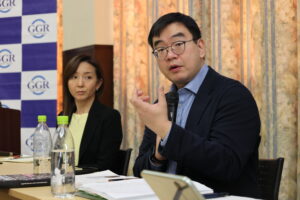
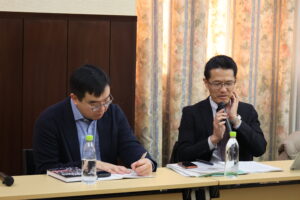
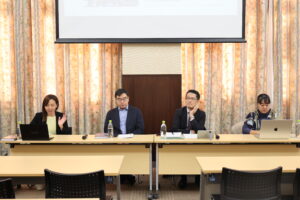
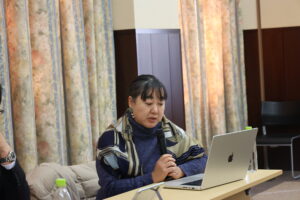
On December 12, 2025, the Research Center for Sustainable Peace (RCSP) at University of Tokyo and the Institute for Global Governance Research (GGR) at Hitotsubashi University jointly held a talk session titled “Professional Awakening from Political Crisis: Legal Resistance under Authoritarianism Book Launch.” The session featured Dr. Eric Yan-ho Lai, Senior Fellow at the Center for Asian Law, Georgetown University Law Center. Professor Tomoko Ako (University of Tokyo) and Professor Makoto Tajimi (Hitotsubashi University) also attended the session as discussants.
Dr. Lai introduced the academic background and key arguments of his book, Legal Resistance Under Authoritarianism: The Struggle for the Rule of Law in Hong Kong. Based on fieldwork conducted from 2018 to 2020 and published in 2022, the book is among the limited number of overseas academic studies documenting Hong Kong’s legal and political changes during a sensitive period. His research draws on interviews with over 75 legal professionals and experts, including solicitors, barristers, academics, and former judges.
A central focus of the talk was the changing relationship between legal professionalism and political power. Dr. Lai discussed the case of Calvin Yap, an exiled lawyer who faced strong political and professional repercussions after advocating internationally, including in U.S. policy spaces. Dr. Lai then explored different understandings of the rule of law, contrasting sociological and doctrinal perspectives. He argued that rule of law depends not only on legal institutions and procedures, but also on neutral processes, constraints on arbitrary authority, and a shared commitment to universal rights. In authoritarian contexts, however, rule of law may be reframed as “rule by law,” where legal mechanisms serve executive control rather than limiting state power. The session also connected these ideas to Hong Kong’s governance under “One Country, Two Systems,” noting the narrowing path toward democratization after 2014 and the emergence of major protest movements.
Finally, Dr. Lai identified three main strategies of legal resistance: public education, legal services for protesters, and participation in professional-body elections. He emphasized that post-2020 arrests, information control, and legal pressure have severely constrained these efforts, although civic inquiry and resistance continue in some forms. Following the lecture, Professor Tomoko Ako and Professor Makoto Tajimi offered brief comments on Dr. Lai’s book. The session concluded with an active Q&A.
【Event report prepared by】
Billal Hossain (Doctoral Student, Graduate School of Law, Hitotsubashi University)
 |
 |
 |
 |