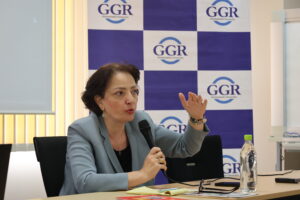
December 2, 2025, the Institute for Global Governance Research (GGR) at Hitotsubashi University held the GGR Talk Session titled “Small States in Turbulent Regions: Lessons from Georgia’s Current Political Challenges.” The speaker was Ms. Tinatin Khidasheli, Chairperson at Civic IDEA and former Defense Minister of Georgia.
Ms. Khidasheli began by outlining Georgia’s geopolitical position and the political crisis the country currently faces. Georgia is located between Russia and Turkey, while also falling within the spheres of influence of Iran and China. It serves as a key energy transit route connecting the Caspian Sea to Europe and as a central hub of the Middle Corridor linking Asia and Europe via the Black Sea, giving it significant strategic importance in both energy and trade. Domestically, the government has increasingly leaned toward Russia, and since the suspension of EU accession negotiations in November 2024, protests have continued. In addition, two regions broke away in 1991 and were recognized by Russia as independent states, though only a limited number of countries support this status, leaving the situation in a prolonged state of frozen conflict.
Ms. Khidasheli then discussed major ongoing projects in Georgia. First, she highlighted the growing influence of China. Although Georgia and China signed a strategic partnership agreement in July 2023, nearly 90 percent of the businesses registered between 2023 and 2024 failed, and despite an 800 percent increase in cumulative transactions, most consisted of unilateral imports of Chinese products. Second, she addressed the development of Anaklia Port. The project was launched in 2018 through a consortium with the United States, but it stalled after the founder was criminally prosecuted by the Georgian government and Russia opposed the construction of an alternative transport route. A Chinese company later announced its intention to take over the project, but no contract has been signed, and no budget has been allocated for 2026. Ms. Khidasheli emphasized that although the project is of critical strategic importance for Georgia, the current government is unlikely to see it through.
Finally, Ms. Khidasheli discussed regional dynamics and Georgia’s future prospects. She predicted that China and Russia—both of which view the liberal democratic world as a common adversary—would deepen their cooperation in Georgia. At the same time, she noted that the peace agreement between Armenia and Azerbaijan could, for the first time, enable the region to unite in resisting Russian dominance. She also raised the possibility that the Georgian government might hold a referendum to remove constitutional provisions on EU and NATO membership. However, given that approximately 85 percent of the population supports EU accession, she argued that such an attempt would face significant obstacles.
【Event Report prepared by】
Takakura Akari (Undergraduate student, Faculty of Law, Hitotsubashi University)
 |
 |