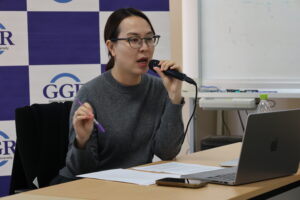
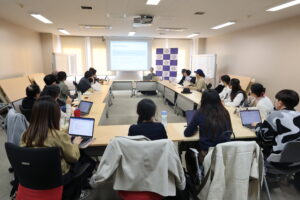
On November 7, 2025, the Institute for Global Governance Research (GGR) at Hitotsubashi University held the 44th GGR Brown Bag Lunch Seminar titled “How Voters Shape U.S. Trade Policy: Public Opinion and Protectionism in Trump 2.0,” featuring Dr. Ji Yeon Park, Assistant Professor, Graduate School of Law, Hitotsubashi University.
Dr. Park began her speech by highlighting the crucial role of public opinion in shaping U.S. trade policy, particularly during the Trump era. She emphasized that voters’ attitudes toward free trade agreements (FTAs) and tariffs significantly influence political leaders’ policy positions. Using data from the Pew Research Center Survey, Dr. Park explained the central puzzle of why protectionist policies gained popularity despite the economic benefits of trade liberalization. The seminar demonstrated how elite cues, especially from political leaders, can reshape public preferences and legitimize protectionist trade policies.
According to Dr. Park, political leadership plays a decisive role in aligning voter attitudes with policy positions. She discussed how Donald Trump’s opposition to FTAs during the 2016 presidential election influenced Republican voters’ perceptions of trade agreements. Furthermore, she presented findings from a survey experiment conducted during the 2020 election campaign regarding the U.S.–Japan trade agreement. The results showed that respondents’ support for or opposition to the agreement varied depending on whether their favored presidential candidate supported or opposed it.
During the Q&A session, Dr. Park addressed questions related to changes in public opinion during the “Trump 2.0” period. She explained that public attitudes toward FTAs and tariffs shifted noticeably alongside political rhetoric and policy implementation. The discussion also focused on Trump’s protectionist measures, particularly the increased use of tariffs, and how these policies reflected evolving voter preferences rather than purely economic considerations.
In conclusion, Professor Dr. Park underscored that voters play a central role in shaping trade policy outcomes in democratic systems. The seminar highlighted how elite cues and partisan alignment can significantly influence public opinion, leading to major shifts in trade policy such as increased protectionism. By combining theoretical insights with empirical evidence, the seminar provided a clear understanding of the interaction between voters, political leaders, and U.S. trade policy, offering valuable perspectives for future research and policy discussions.
【Event report prepared by】
Billal Hossain (Doctoral Student, Graduate School of Law, Hitotsubashi University)
 |
 |