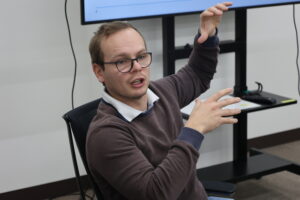
On December 1, 2025, the Institute for Global Governance Research (GGR) at Hitotsubashi University held the 46th Brown Bag Lunch Seminar titled “Populism Goes Global: International Solidarity on Twitter Around Populist Leaders Across Nations.” The seminar featured Sergio Zanotto, a doctoral candidate at the University of Konstanz, as the guest speaker.
In his lecture, Mr. Zanotto presented joint research on the attitudes of populist leaders toward international solidarity (IS). Although recent global crises—such as the COVID‑19 pandemic and the Russian invasion of Ukraine—have heightened the importance of international solidarity, populist leaders often challenge the legitimacy of international cooperation and international organizations. The study by Zanotto and his colleagues examines the conditions under which political leaders discursively construct a common populist frame when discussing IS.
The analysis identified tweets related to IS posted between 2010 and 2014 by 28 political leaders across seven countries. It then assessed how leaders’ populist tendencies, their roles within government, whether their country was a donor or a recipient, and their political orientation influenced their stance toward IS. The findings show that: (1) populist leaders are more critical of IS than non‑populist leaders; (2) political leaders tend to become more supportive of IS once they assume important government positions; (3) populist leaders in donor countries are more critical of IS than those in recipient countries; and (4) left‑ and right‑wing populist leaders criticize IS in similar ways, but they target different categories, such as migrants or international organizations.
During the Q&A session, participants raised a wide range of questions, including details about the machine‑learning model used in the analysis, the history of populism in Europe, and differences between left‑wing and right‑wing populists. Mr. Zanotto concluded by reiterating that populism should be understood primarily as a communicative style rather than an ideology.
【Event Report prepared by】
Akari Takakura (Undergraduate student, Faculty of Law, Hitotsubashi University)