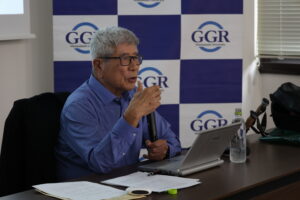
On October 13, 2025, the Institute for Global Governance Research (GGR) at Hitotsubashi University hosted the GGR Talk Session “The Role of Ideology in Soviet Policy During the Cold War” featuring Professor Tsuyoshi Hasegawa (Professor Emeritus, Department of History, University of California, Santa Barbara) as a guest speaker.
Professor Hasegawa, referring to the Cold War studies of Professor Toshihiko Aono (Professor, Graduate School of Law, Hitotsubashi University) and Nobuaki Shiokawa (Professor, Graduate Schools for Law and Politics, The University of Tokyo), emphasized that ideology played a role in Soviet policy that went far beyond merely justifying geopolitical interests.First, ideology defined the core principles of the Soviet system — such as the one-party dictatorship and the command economy — and thereby shaped the Cold War as a confrontation between two mutually exclusive ideological blocs. Furthermore, ideology played a central role in forming both the opposing framework of “anti-imperialism and anti-capitalism” versus “anti-communism” and the worldview of the Soviet leadership itself.
Ideology also influenced several key aspects of the Cold War. The mission to demonstrate the superiority of the socialist system drove competition in industrialization and modernization, while the strong imperative to defend the regime and its core principles intensified the arms race and nuclear buildup. At the same time, the expansion of military spending and the militarization of the Soviet economy led to economic stagnation and deepened the contradictions between socialist ideals and reality. During Gorbachev’s perestroika, the emphasis shifted from “class struggle” to “common human values,” and ultimately, the collapse of ideology led to the collapse of the Soviet Union itself.
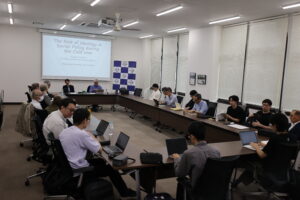
In the latter part of the talk session, Professor Hasegawa took questions from the audience, sparking an active discussion. During the Q&A, Professor Shiokawa and others exchanged views on the diverse interpretations of ideology and its concrete impact on Soviet foreign policy. The discussion also extended to the trends of economic reform and marketization that emerged after the 1960s.
【Event report prepared by】
TAKAKURA Akari (Undergraduate student, Faculty of Law, Hitotsubashi University)
 |
 |